

Quick answer
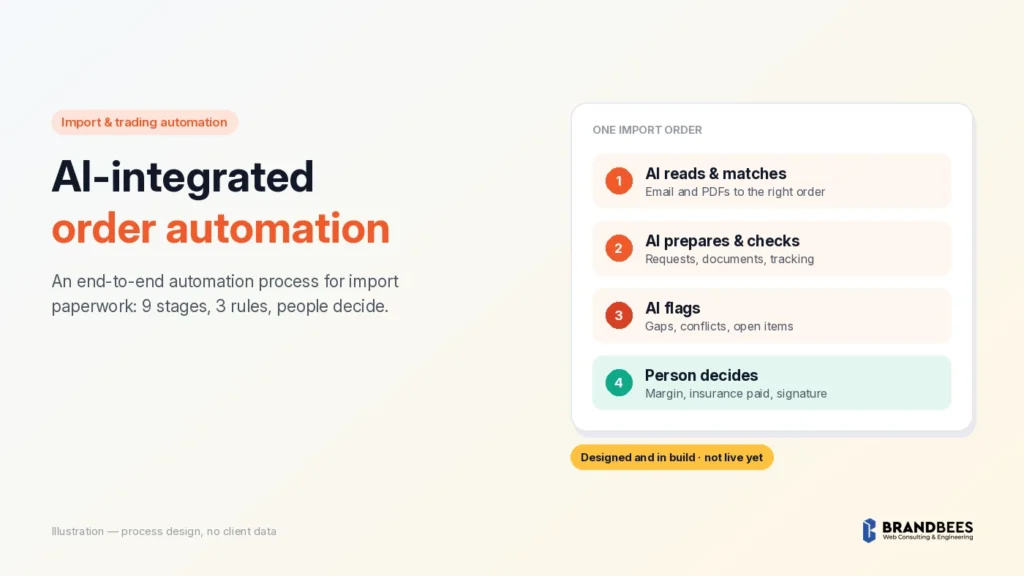
AI-integrated decision making in an end-to-end automation process means AI reads every order email and PDF, matches it to the right order, prepares the next request, checks the documents and flags problems, while a person makes the final decisions on money and signatures. For Genius Impex, a polymer import business, BrandBees mapped 54 real orders into a 9-stage flow with three safety rules. The system is designed and in build, not live yet.
I build automations for clients every week. This month we mapped the messiest workflow I know: my own. Genius Impex is my polymer import business, and every material order runs on email and PDFs. Here is how we designed an end-to-end automation process for it, with AI doing the groundwork and people keeping the final say.
Why import orders drown in email
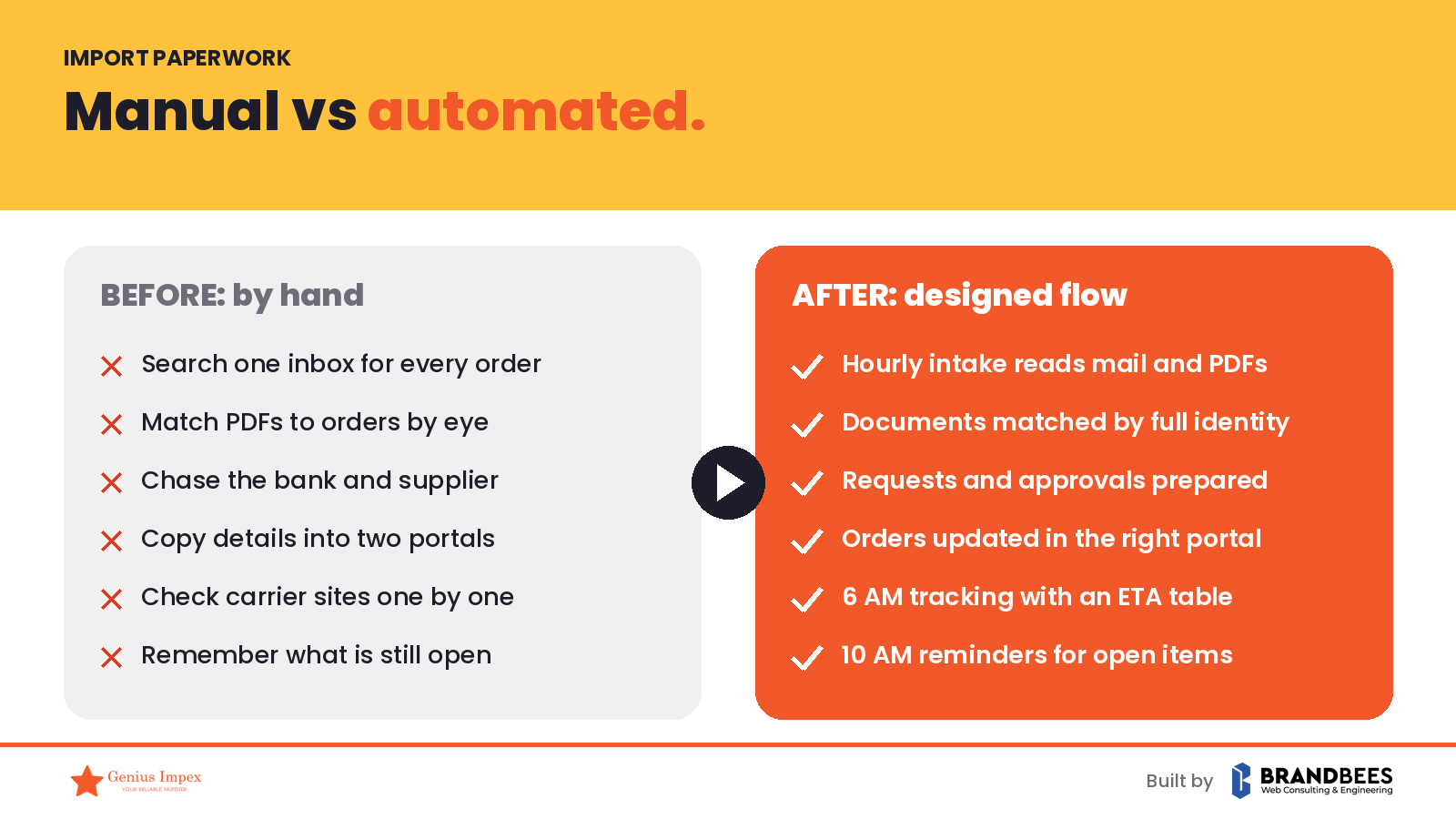
One order is a long chain: a proforma invoice from the supplier, a draft from the bank, approvals going back and forth, insurance cover, shipping documents, then the wait for the cargo to arrive and clear the port. Two companies, two separate portals, one inbox. Each step means someone finding the right email, matching it to the right order and updating it by hand.
What AI-integrated decision making means here
We split every decision into two kinds. Routine decisions follow written rules, so AI can make them and log why. Decisions about money, risk or a signature go to a person, with the facts already gathered.
- AI reads and matches: new emails and PDFs are read, and each document is matched to the right company and order.
- AI prepares: it drafts the next request, such as the bank draft or insurance cover request, and turns signed letterheads into PDFs.
- AI checks: it compares final documents against what was asked for, and tracks shipments every morning.
- AI flags: missing documents, conflicting facts and overdue items go to a review queue or a reminder.
- A person decides: the margin percentage, marking insurance as paid and signing documents.
Discovery first: 54 real orders
Before writing any code, my team at BrandBees went through 54 published orders across both companies: 46 delivered and 8 still in progress. We read the documents and the email chains behind them to see how orders really move, not how we assumed they did.
The 9-stage end-to-end automation process
Out of discovery came a 9-stage flow. Stages can overlap, since shipping papers sometimes arrive before the bank replies, but an order never moves backwards.
- Hourly intake: new emails and PDFs are read and matched to the right company and order.
- Publish the order: a clear proforma invoice creates the order automatically. Anything unclear goes to a review queue.
- Bank and insurer: the bank draft and the insurance cover are requested.
- Approval loop: the draft goes to the supplier, and their approval goes back to the bank to transmit.
- Final documents: final papers and amendments are matched, filed and checked.
- Shipping documents: shipment details and insurance records are filled in.
- Payment status: document arrival and payment stages follow clear rules.
- 6 AM tracking: carrier and port status is checked and an ETA table is sent.
- 10 AM reminders: anything still open gets a follow-up.

The daily rhythm
The system works on a simple timetable: intake every hour, tracking at 6 AM, reminders at 10 AM, and no reminders on Sundays.

Three rules that make AI decisions safe
The surprising part wasn’t the tech. It was the rules. Most automation projects fail on edge cases, not on tools.
- A reference number alone isn’t an identity. We found the same reference reused across the two companies, two years apart. Matching uses company, supplier, reference, date and product together.
- Never move an order backwards just because someone forwarded an old email.
- A bank’s “transmitted” reply doesn’t prove the corrections were applied. Check the final document.

What stays human
The system prepares, checks and follows up. It doesn’t decide. Margins, insurance payments and signatures stay with me.
Hassan Ejaz, founder of BrandBees and Genius Impex
That line is the design principle. AI handles the volume, and a person handles the judgement.
Where it stands today
To be clear: this isn’t live yet. Discovery is done, the rules are written, and we’re building it now, stage by stage, with checks before anything runs unattended. I’ll share what breaks along the way.
Automating your own trading business
If your import, export or trading business runs on emails, PDFs and spreadsheets, the same approach works: map the real process, write the rules, keep people on the key decisions, then automate the rest. See our workflow automation service, or start with our free guide to self-hosting n8n.
Frequently asked questions
What is AI-integrated decision making in order automation?
AI does the reading, matching, preparing and checking, then flags anything unclear. A person makes the final call on decisions that involve money, risk or a signature. In our import workflow, AI never confirms the margin, marks insurance paid or signs a document.
What does an end-to-end automation process for import orders cover?
It covers the whole order, not one task: email and PDF intake, creating the order from the proforma invoice, bank and insurance requests, the supplier approval loop, final documents, shipping documents, payment status, daily carrier and port tracking, and reminders for anything still open.
Is the Genius Impex automation live?
Not yet. Discovery is complete and the rules are written. The system is being built and tested stage by stage, and it will not run unattended until each stage has been checked.
Why not let AI make every decision?
Because some mistakes are expensive and hard to undo. AI is good at spotting a missing document or a mismatch, but a person who knows the business should approve payments, margins and signatures. The automation prepares the facts so that decision is quick.
How do you stop automation from matching a document to the wrong order?
A reference number alone is never treated as an identity. Matching uses the company, supplier, reference, date and product together. If the evidence is incomplete or conflicting, the document goes to a review queue instead of being guessed.
Can this work for other import, export or trading businesses?
Yes. Most trading businesses run on emails, PDFs and spreadsheets. The same approach applies: map the real process, write rules for the edge cases, keep people on the key decisions, then automate the rest.
Let’s map your workflow
Tell us which step in your order process costs you the most time, and we’ll show you what AI can safely prepare and what should stay with your team. Contact BrandBees
Free PDF
WordPress Security Checklist
The same checks we run on client sites, written in plain English. Work through it in an afternoon.
- Logins, updates, backups and hosting, step by step
- A 10-minute self-test you can run today
- What to do if you think you’ve been hacked
Need this handled for you? Our WordPress malware removal service cleans hacked sites from $149, with standard infections cleaned within 24 hours of access.
